
Frequently Asked Questions for Members
The deposit-refund system modernization
Why is the deposit-refund system being modernized?
The current deposit-return system dates to 1984, so an overhaul was needed. In 2022, to help improve recovery and recycling of our beverage containers, the Government of Quebec enacted a law that lays out the bases for modernization of the system.
One of the Government’s objectives is to increase the recovery rate for redeemable beverage containers to 90% by 2032.
What are the main changes being made to the deposit-refund system?
Phase 1 – As of November 1, 2023:
- The deposit amount is now 10 cents: the amount of the deposit on the majority of redeemable beverage containers is now 10 cents, except for glass bottles of between 500 mL and 2 L, which are already redeemable and for which the amount is 25 cents.
- All aluminum ready-to-drink beverage containers of between 100 mL and 2 L are redeemable.
Phase 2 – Beginning March 1, 2025:
- Deposit-refund is expanded to all plastic ready-to-drink beverage containers of between 100 mL and 2 L, including water, sparkling water and juice bottles;
- The network of beverage container return locations is transformed, with, among other things, implementation of Consignaction and Consignaction+ return sites exclusively dedicated to recovery of beverage containers. These return sites feature state-of-the-art, high-performance equipment with the capacity to handle the expected large volumes of containers.
Phase 3 – Beginning March 1, 2027:
- Deposit-refund is expanded to all glass and multi-layer carton ready-to-drink beverage containers of between 100 mL and 2 L;
- A total of 5 billion beverage containers will be subject to deposit-refund in Quebec.
Key dates in the modernization of the deposit-refund system
Which beverage containers are included in the Quebec deposit system; i.e., redeemable?
In Quebec, redeemable beverage containers include:
- The vast majority of soft-drink and beer containers
- All ready-to-drink beverage cans of between 100 mL and 2 L
- All plastic ready-to-drink beverage containers of between 100 mL and 2 L, including bottles of water, sparkling water, juice, milk, and spirits
To find out which beverage containers are redeemable and which are not, see the page Targeted and non-targeted containers on the website.
See also the List of all redeemable beverage containers and the amounts of the deposit applicable
Which beverage containers are not redeemable in Quebec?
In Quebec, non-redeemable beverage containers include:
- Glass bottles of wine and spirits (redeemable in 2027)
- Cartons of juice, milk and other beverages (redeemable in 2027)
- Drinkable yogurt and meal supplements
- Family-size canned juices and cans
- All beverage containers of LESS THAN 100 mL and MORE THAN 2 L, regardless of material
To find out which beverage containers are redeemable and which are not, see the page Targeted and non-targeted containers on the website or the List of returnable beverage containers and deposit-refund.
Are wine and spirits bottles, as well as juice and milk cartons, returnable?
No. The Quebec government has postponed the deposit-refund on wine and spirits bottles and multilayer cartons until March 1, 2027.
Does the SAQ participate in the deposit-refund system?
Yes, the Société des alcools du Québec (SAQ) has a regulatory obligation to participate in the deposit-refund system, as do all other producers
Producers
What is a beverage producer?
What about the producer who is also a retailer or an on-site consumption establishment?
What are the producer's obligations in the system of deposit-refund modernized?
Are there any penalties if the producer does not meet its regulatory obligations?
How do I become aQBCRA member? What information do I need to provide?
- the producer's full contact details;
- the types of products targeted for marketing, the brands and the status of the producer with regard to these products: brand owner, first supplier , etc.
What is the Member Portal?
- complete and submit monthly declarations in the Declaration Management > Declarations section.
- communicate company contact details and contacts in addition to managing account users in the Account section.
- file and update the list of registered products that are marketed by the producer in the Product Management > Products section.
- have quick access to various information and regulatory documents related to the system deposit-refund modernized. These resources are available in the Members > Information section.
How often should the list of marketed products be updated?
Deposit-refund amount and invoice
What is the amount of the deposit on beverage containers?
Most beverage containers are redeemable for 10 cents, except for certain glass bottles of 500 mL and more, which are already redeemable and for which the deposit amount is 25 cents.
See Fact Sheet – Phases 1 and 2 – Amount of the deposit on redeemable beverage containers in the press room.
Should the amount of the deposit on redeemable beverage containers appear on the sales receipt?
Yes. Retailers are obliged to indicate the amount of the deposit on the sales receipt. More precisely: “The amount of the deposit must also appear on the invoice for the person who purchases the product, on a line just below the line indicating the amount of the sale.”
To learn more, read Article 52 of the Regulation Respecting the Development, Implementation and Financial Support of a Deposit-Refund System For Certain Containers.
Should the amount of the producer's financial contribution appear on the invoice?
About returnable beverage containers
Are steel beverage containers returnable since March 1, 2025?
Do producers have to have their beverage containers approved byQBCRA before marketing them?
Will beverage containers from outside Quebec be subject to a deposit?
Is the producer required to indicate on the product label that beverage containers are returnable?
Is it allowed to use plastic sleeves or labels?
Return of redeemable beverage containers
How do people know whether a beverage container is redeemable?
It is no longer necessaryto look for the words “Consignée Québec” on redeemable beverage containers. To find out whether a container is redeemable, refer to the question “Which beverage containers are included in the Quebec deposit system; i.e., redeemable?” in this FAQ list, or view What to return > Targeted and non-targeted containers. You can also view the List of returnable beverage containers and deposit refund applicable.
Collection of returnable beverage containers
Due to the additional volumes of beverage containers we have been receiving since March 1, 2025 following the entry into force of the deposit-refund Are additional collection circuits planned for plastic beverage bottles?
What procedure should the retailer or the on-site consumption establishment (ÉCSP) if its storage space is overflowing or if it wants to request a change to the collection schedule?
Refund
How are redeemable beverage containers refunded?
For full details on refund methods, see Return sites on the website.
Can I donate a refund that I obtain for returning redeemable beverage containers?
You can donate a refund amount to an organization by contacting them directly.
Product list update, monthly reporting and audit
What must the producer declare?
How to produce a monthly declaration?
What is the deadline for providing the list of returnable products?
Are there any changes to note for producers who are already members and who already make a monthly declaration?
What happens when a producer files their declaration late, after the 15th of the month? What are the consequences?
What happens to declarations previously made to Éco Entreprises Québec? Are they maintained?
What about the declaration for the corks?
How to make payments of the amount of the deposit-refund and the producer's contribution?
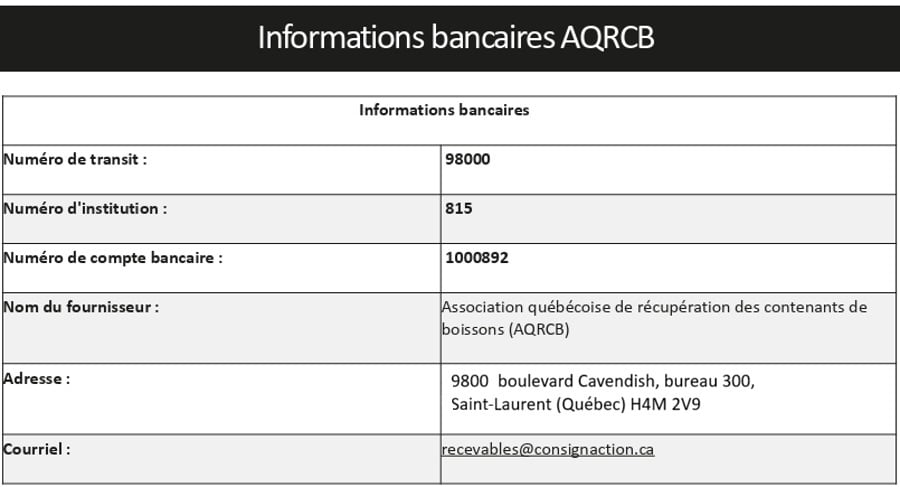
For more information, consult the QBCRA 2025 Member's Guide in the section Members.
Financial contribution from the producer
What is the producer's financial contribution?
To learn more, read article 94 of the Regulation Development, implementation and financial support of a system of deposit-refund of certain containers.
Is the contribution the same for all producers, large or small?
How does the producer pay his contribution?
How should the producer's financial contribution be internalized? Should it be made visible?
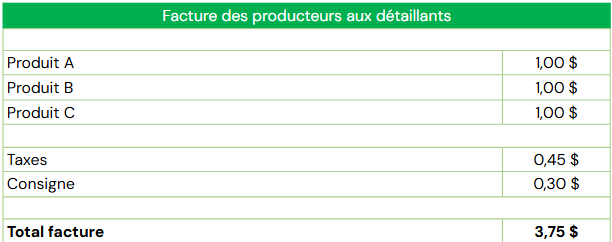
Example #2 - The contribution is internalized in the price and is made visible (display) :
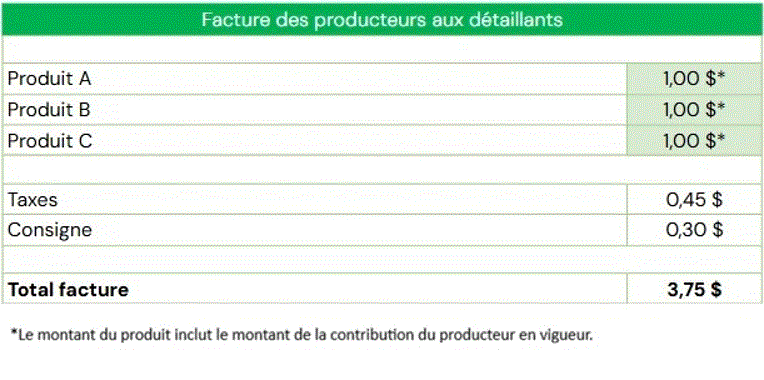
From what date will the producer have to pay the contribution?
Does the producer have to inform retailers of the amount of the financial contribution he pays?
Will the producers' financial contribution be reassessed each year?
Are there any subsidies to mitigate costs, particularly for the implementation of measures related to the modernization of the system? deposit-refund ?
Multi-refillable container management (CRM)
Refillable containers (RCCs) were previously subject to a deposit-refund private sector managed by producers. Since March 1, 2025, how does it work?
Can refillable containers (RCCs) carry a deposit-refund particular?
Does the producer have to pay a contribution for refillable containers?
Where to return
Where can people return their beverage containers?
Complete information is available on the Map of return sites on the website.
Where can I return my redeemable beverage containers?
Complete information is available on the Map of return sites on the website.
What types of return site are there in Quebec?
There are two types of return site:
- Zone Consignaction return points (participating retailers)
- Consignaction and Consignaction+ return sites (boutique-style spaces)
Detailed information about the various return sites may be found on the website at Return sites.
What services are provided at Zone Consignaction return points?
The service provided at a Zone Consignaction return point is:
- Single-Unit Return: via reverse vending machines or at the customer service counter.
To learn more about the different types of return site and the services they provide, read Fact Sheet 4.
What services are provided at Consignaction return sites?
The services provided at a Consignaction return site are:
- Single-Unit Return: Deposit-return beverage containers one by one via next-generation automated reverse vending machines. via reverse vending machines.
- Express Return: Drop-off clear bags containing unsoreted of deposit-return containers.
- Containers are counted later, and the refund is issued via electronic transfer.
- Important: This service requires the Consignaction mobile app.
To learn more about the different types of return site and the services they provide, read Fact Sheet 4.
What services are provided at Consignaction+ return sites?
The services provided at a Consignaction return site are:
- Single-Unit Return: Deposit-return beverage containers one by one via next-generation automated reverse vending machines. via reverse vending machines.
- Express Return: Drop-off clear bags containing unsoreted of deposit-return containers.
- Containers are counted later, and the refund is issued via electronic transfer.
- Important: This service requires the Consignaction mobile app.
- Bulk Return : Drop-off large quantities of unsorted deposit-return containers.
To learn more about the different types of return site and the services they provide, read Fact Sheet 4.
What are the business days and hours?
The business days and hours of operation of the return sites are as follows:
- Consignaction and Consignaction+ return sites: daily, from 8 a.m. to 6 p.m., except Thursday and Friday (8 a.m. to 7 p.m.). These return sites are closed on January 1 and 2, June 24, and December 24, 25, 26 and 31.
- Zone Consignaction return points (participating retailers): Business hours correspond to those of the retailer.
All Consignaction and Consignaction+ return sites are closed on the following dates: January 1 and 2, June 24, and December 24, 25, 26 and 31.
Are Consignaction and Consignaction+ return sites adapted for people with reduced mobility?
Yes, all Consignaction return sites are accessible by people with reduced mobility.
How can I be informed of the opening Consignaction return sites?
The opening of return sites are communicated to municipalities and the media.
Return sites network
Why is the network of return sites transforming?
In 2023, the Ministère de l’Environnement du Québec has modernized the province’s deposit-refund system with the objective of improving recovery and recycling and helping to grow the circular economy.
To successfully implement modernization, it was essential that the network of redeemable beverage container return sites be transformed. This means changing from a return-to-retailer model to a hybrid model that includes:
- Spaces that are branded Consignaction and Consignaction+, exclusively dedicated to returns of redeemable beverage containers; and
- Zone Consignaction return points at participating retailers.
The purpose of the change is to gain the capacity to process the expected large volumes of containers and achieve the target recovery rate of 90% by 2032.
How many return sites will there be as of March 1, 2025?
The network will comprise more than 3,500n return sites by March 1, 2025.
Given that many smaller retailers are no longer accepting returns of redeemable beverage containers, will the new network keep up with demand?
Yes. The network of return locations is being transformed and optimized. There will eventually be fewer locations, but the new Consignaction and Consignaction+ return sites have the capacity to receive and process much larger volumes of beverage containers thanks to high-performance, efficient equipment that uses state-of-the-art technology.
With all these changes under way in the return sites network, how will people keep up?
People can consult the Map of return sites on the Consignaction website at any time to find the site nearest them.
Since November 1, 2023, retailers who used to recover redeemable beverage containers have been required to post a sign at the entrance to their business indicating whether they still do. If they do not, they must post the address of the nearest return site.
How are people being informed if a retailer is no longer accepting returns?
A retailer who will no longer be accepting returns of redeemable beverage containers is required to give people approximately one month’s notice by posting a sign at the entrance to their store providing the address of the nearest return site.
If the retailer is part of a group, they must use the posters e-mailed to them by the QBCRA once the grouping is in effect. The posters can also be downloaded via the retailers’ account once the grouping has been confirmed.
Zone Consignaction
What is a kiosk?
A kiosk is an outdoor facility equipped with reverse vending machines, located close to a retailer’s main building, e.g., in the parking lot. People can drop off their redeemable beverage containers there, except for redeemable beer bottles (MFCs), which must be taken to the service counter inside. Kiosks are branded with the Consignaction colours and the Zone Consignaction symbol :

Grouping of return sites
Why are some retailers no longer accepting returns of redeemable beverage containers?
There are three main reasons why some retailers are no longer accepting returns:
- Pursuant to deposit-refund modernization, retailers with smaller sales areas, equal to or less than 375 m2/4,036 sq ft (for example, small grocery stores and dépanneurs), were no longer required as of November 1, 2023, to accept returns of redeemable beverage containers. Some smaller-size retailers, however, have chosen to voluntarily continue to accept returns.
- Other retailers are no longer accepting returns because they grouped together with another return point (a targeted retailer, i.e., with a sales area larger than 375 m2) located nearby and as a result they are no longer required to offer the service directly. These retailers are required to post a notice at the entrance to their store providing the address(es) of the nearest location(s) where citizens can now return containers.
- Still other retailers, who had been participating in redeemable beverage container recovery on a volunteer basis, have decided to no longer do so.
Recycling of containers included in the deposit system
What happens to aluminum beverage containers after I return them? What about plastic ones? And glass?
Once you’ve finished your drinks and taken the containers to a return location, the containers embark on a long recycling journey. Depending on what they’re made of—aluminum, plastic or glass—beverage containers will find new life as another container or be repurposed into something new. To learn all about what happens to beverage containers, from the retailer’s shelves to the recovery facility, processing plant and recycling plant, go to The Container’s Journey or watch the informational video The Infinite Life Cycle of an Aluminum Can.
What happens to the recovered materials?
You can make a thousand-and-one things out of empty cans or bottles. Not only can aluminum, plastic and glass be recycled into new containers, but they are also used to manufacture hundreds of practical items, from clothing to bicycles, cars, construction materials and much, much more.
Communication
How can the producer participate in communication efforts as part of the modernization of the deposit-refund ?
How is the producer informed of changes in the system? deposit-refund ?
- to communications from its associations, such as the Association des brasseurs du Québec, the Association des microbrasseries du Québec and others;
- the website www.consignaction.ca. This site contains a wealth of information on deposit-refund systems deposit-refund general. In the Members section, producers will find information relevant to them;
- to webinars for producers;
- to newsletters sent to them;
- to an advertising campaign that began on January 13, 2025 on various platforms: television, radio, print, urban displays, Internet and social media;
- to activities organized to inform the media who, in turn, will relay the information to the general public.
Customer Service
Any questions?